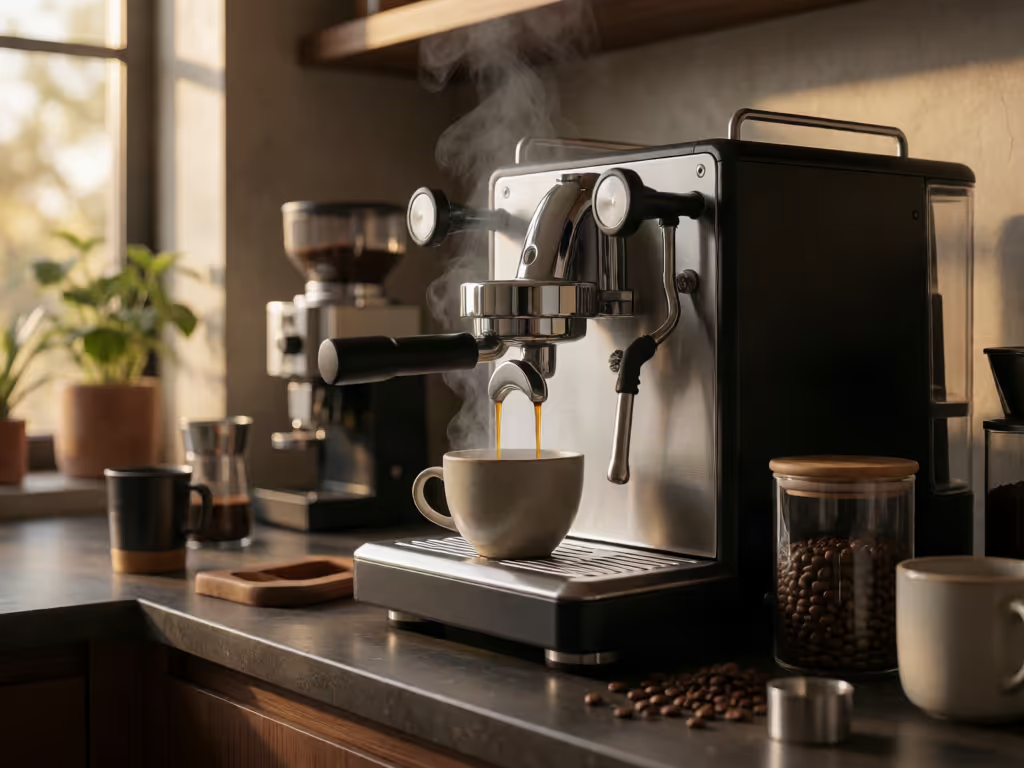
Espresso Machine Drink Volume Programming for Consistent Shots
By Maya Desai • 12th Nov
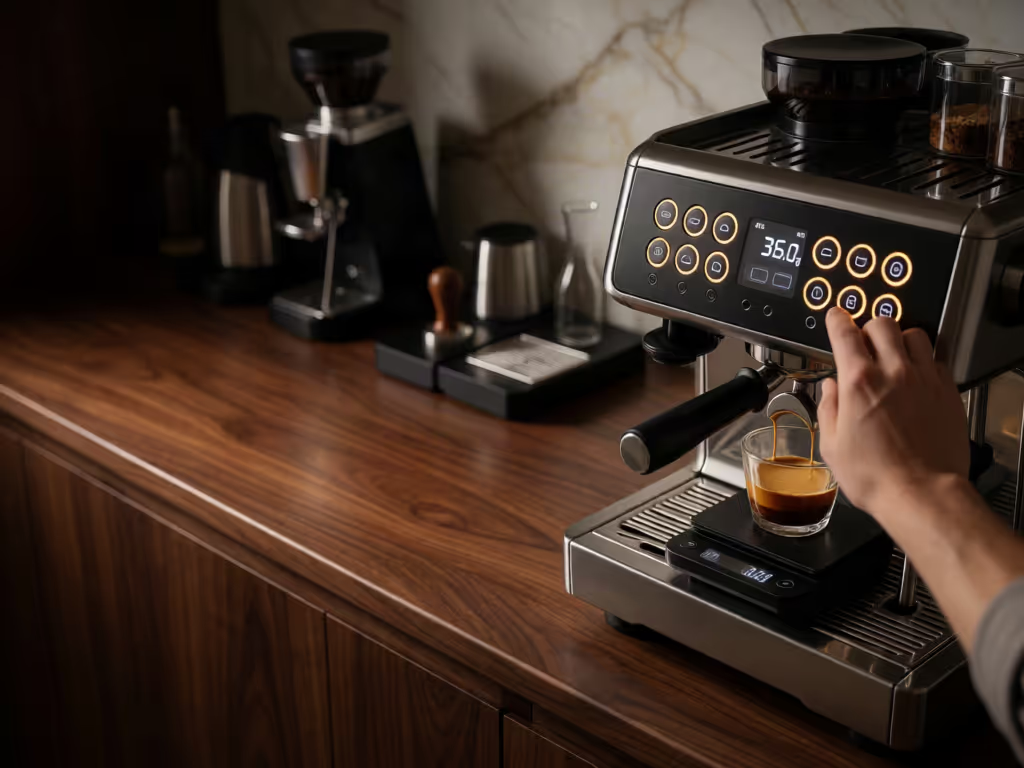
Quick answer
Espresso drink-volume programming improves repeatability only when you know what the machine measures. Traditional volumetric buttons usually repeat a metered-water stop signal, not the final espresso mass in the cup; brew-by-weight systems target beverage mass more directly, while timed programs repeat duration.
- Measure the recipe: Use a scale to check final settled beverage yield, because crema can make visible cup volume misleading.
- Program cautiously: Dial in the recipe manually first, then follow the exact machine manual. Recheck the preset after changing beans, dose, grind, or other important variables.
- Interpret labels carefully: “Single,” “double,” and “automatic” do not establish a universal dose, yield, or stopping mechanism. Yield automation also cannot guarantee balanced flavor.
Important: Programming and reset procedures vary by model, and inconsistent behavior may reflect a hardware or water-system issue rather than merely lost settings.
Espresso machine drink volume programming can make a home routine substantially more repeatable, but its value depends on what the machine is actually measuring. Many programmable espresso shot buttons do not measure the espresso collected in the cup; they repeat a machine-side stop signal. Understanding that distinction is the practical route to faster mornings, fewer surprises, and better taste consistency over time.
For a home barista, the relevant comparison is not simply programmed versus manual. It is what the program holds constant, what still varies, and how easily the result can be checked. Consistency beats charisma when the alarm is barely past snooze.
The Central Comparison: Time, Water, or Beverage Mass
Automatic shot controls can appear identical from the kitchen counter: press a button, and the machine stops. Their control logic, however, may differ materially.
| Control method | Stop signal | What it does not directly establish |
|---|---|---|
| Timed program | Elapsed duration | Beverage mass in the cup |
| Traditional volumetric program | Metered water moving through the machine | Beverage mass in the cup |
| Brew-by-weight program | Beverage mass feedback from the cup | Whether the extraction tastes balanced |
| Manual stop | The user’s command | Final yield and flavor |
A traditional volumetric system commonly uses a flowmeter in the water circuit. In a common design, flowing water turns a small internal rotor or impeller, generating pulses that the controller counts. A programmed button stops when it reaches its stored pulse count or calculated metered-water quantity.
That is useful automation. It is not the same as weighing the brewed espresso.
A repeated water target is not automatically a repeated beverage yield.
Water can remain in the coffee puck, while the machine's hydraulic arrangement affects the relationship between water measured upstream and espresso delivered to the cup. Changes in dose, grind, basket, puck resistance, or pre-infusion can therefore change final yield even when the button repeats the same internal target.
Why Espresso Cup Size Accuracy Is a Weak Primary Metric
Visible cup volume is tempting because it is immediate: a line on a shot glass appears to answer whether the preset is correct. It does not provide a reliable final answer.
Crema occupies physical space without a proportional increase in beverage mass. Two shots can look different in volume while delivering a closer mass than their foam levels suggest; conversely, two shots that appear to reach the same line can differ in mass. For assessing a recipe, grams are the clearer measurement.
This is the difference between espresso cup size accuracy and recipe accuracy. Cup size may matter for presentation and workflow, but it is not a substitute for measuring beverage yield.
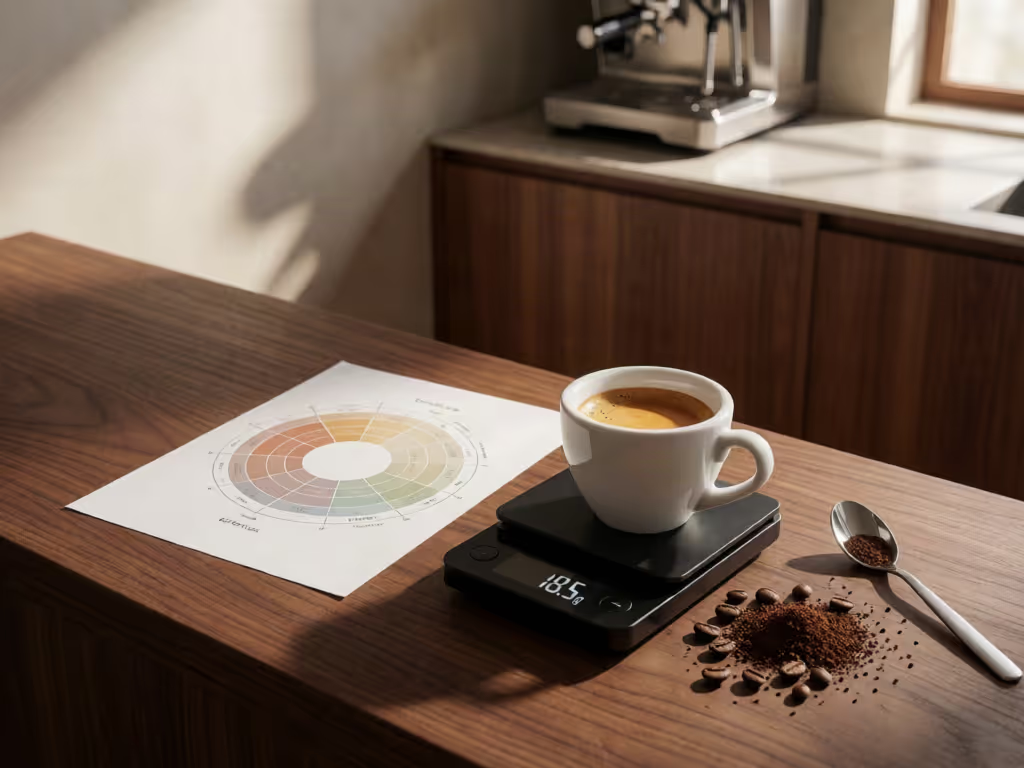
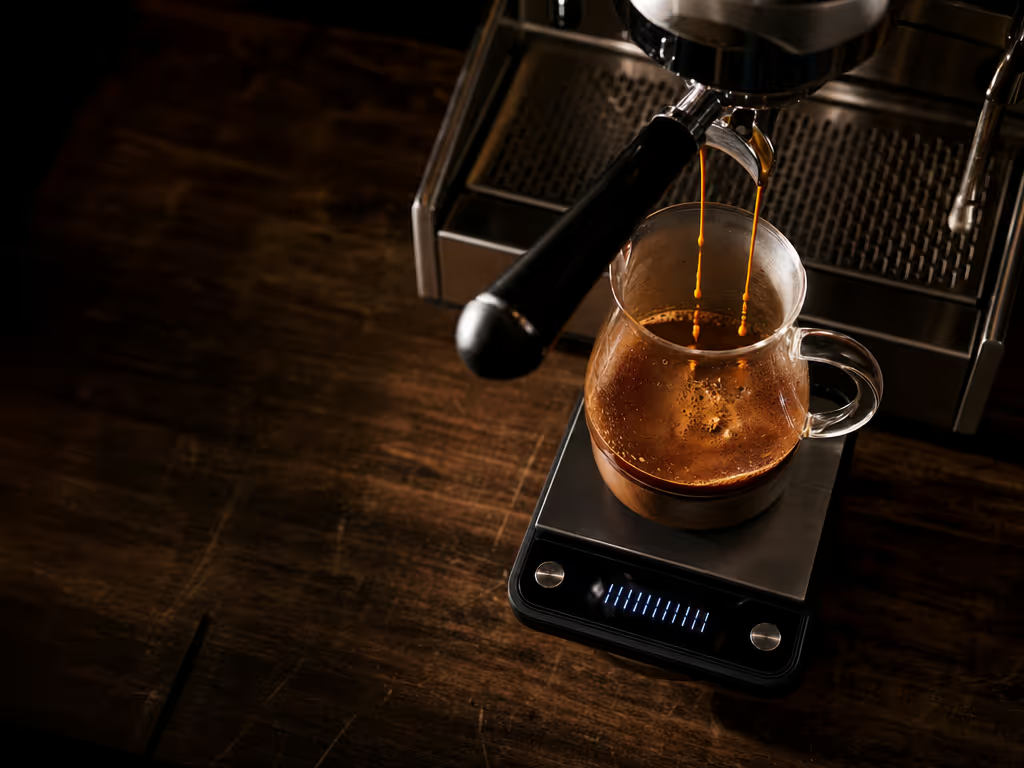
An external scale under the cup is the simplest audit tool: If you want to compare manual weighing with integrated hardware, see our guide to espresso machines with built-in scales.
- Tare the empty cup.
- Ensure the cup is supported freely by the scale and is not touching the machine or drip tray.
- Record final settled beverage mass, not only the reading at the instant brewing stops.
- Record shot time and taste alongside the mass.
The final point matters because a stop command is not necessarily the final yield. Liquid already travelling from the portafilter, plus residual drips, can continue entering the cup after the machine ends the shot.
Volumetric Espresso Dosing Versus Brew-by-Weight
For weekday use, both approaches can be productive; they simply solve different parts of the problem.
Traditional volumetric dosing: efficient repetition
Volumetric espresso dosing is well suited to a stable, already-dialed-in recipe. Once the grinder, dose, and preparation are behaving consistently, a programmed flowmeter target removes the need to watch and manually stop every shot.
Its advantage is operational: press the chosen button, use the brief hands-free interval for the next task, and still retain a repeatable starting point. Its limitation is measurement location. The system is generally metering water in the machine rather than verifying the mass of espresso in the cup.
Brew-by-weight: direct yield feedback
A brew-by-weight system uses beverage-mass feedback to determine the endpoint. This connects the automatic stop function more directly to the yield metric used in a dose-to-yield recipe.
However, a scale that merely displays grams does not make any machine brew-by-weight. The scale must participate in machine control for that description to apply. Even then, target weight, the reading at the stop command, and final settled weight remain distinct points.
Timed programs: useful but less direct
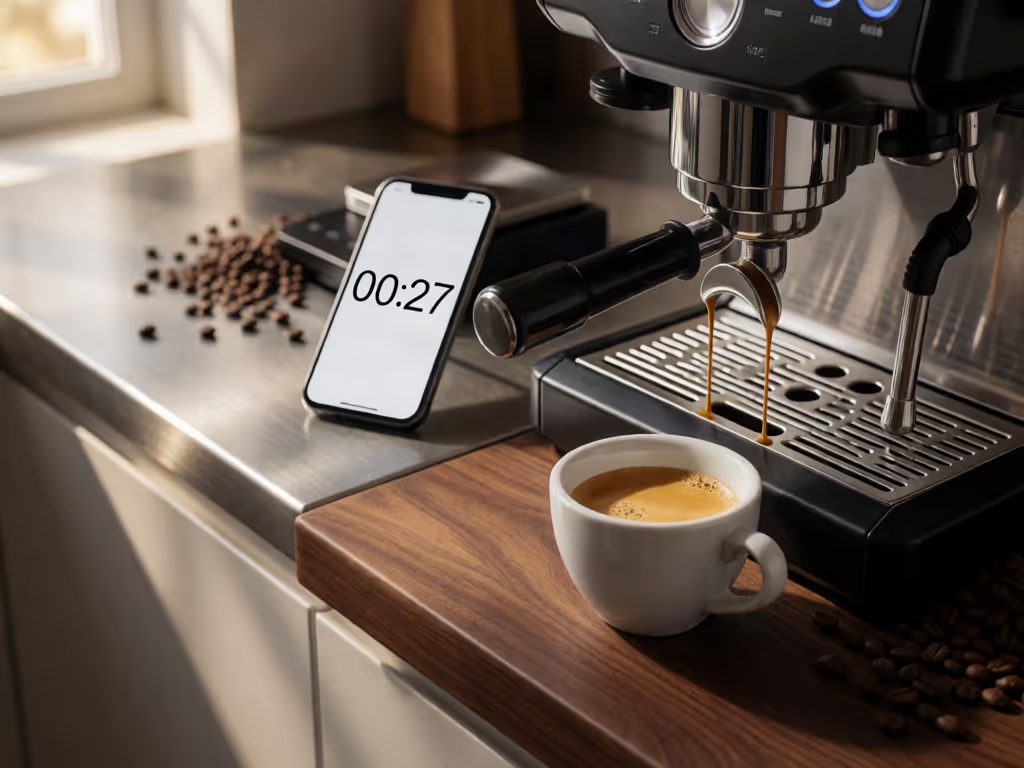
Timed programs hold duration constant. If coffee behavior changes, the mass delivered during that fixed interval may change as well. Timing remains valuable information, but it should be read alongside final yield and taste rather than treated as a complete recipe. For a closer look at integrated timing hardware, explore our espresso machine shot timer guide.
The practical question is whether the button still produces a credible starting point after ordinary changes in preparation. Treat the program as a controlled repeat, not as a guarantee.
A Cautious Workflow for Espresso Shot Volume Settings
The most reliable order of operations is to dial in the coffee recipe first and automate it second. Retailer guidance on volumetric programming follows this sequence, while the exact programming procedure remains specific to the machine's manual.
1. Establish a manual baseline
Dial in the grinder and pull manually stopped shots until the recipe delivers the desired yield and taste. Record:
- Coffee dose in grams
- Final beverage yield in grams
- Shot time
- The sensory result: underdeveloped, balanced, dry, bitter, or otherwise
For example, 18 g in and 36 g out describes a 1:2 dose-to-beverage-yield ratio. It is an illustration of the notation, not a universal espresso rule and not a coffee-to-water ratio.
2. Program the relevant button using the model manual
A general workflow is to enter programming mode, begin a shot, end it at the chosen endpoint, and save that endpoint to the selected button. Some machines may save a flowmeter count; others may use time, beverage weight, or different logic entirely.
The manual for the exact model controls how to enter programming mode, how the setting is saved, and whether a setting applies to other buttons or brewing positions. Do not assume a generic hold-button sequence or reset procedure applies.
3. Test several ordinary shots
Pull several shots with the same beans, basket, dose, grind, preparation, and programmed selection. Weigh the final settled output each time. This checks whether the preset is functioning usefully within your routine.
The purpose is not to assign a universal accuracy tolerance. The practical question is narrower: does the button produce a sufficiently similar starting point that you can make a dependable drink without re-solving the recipe each morning?
4. Recheck after meaningful recipe changes
Reassess the preset when changing beans, roast, dose, grind, or another material recipe variable. The programmed control may repeat its own stop signal while the in-cup yield and flavor shift.
Single vs Double Shot Programming: Labels Are Not Specifications
Single vs double shot programming is often misunderstood because the label on a button sounds more standardized than it is. A button marked "single," "double," or "automatic" does not, by itself, identify whether the machine stops by time, metered water, or beverage mass. It also does not establish a universal dose or yield.
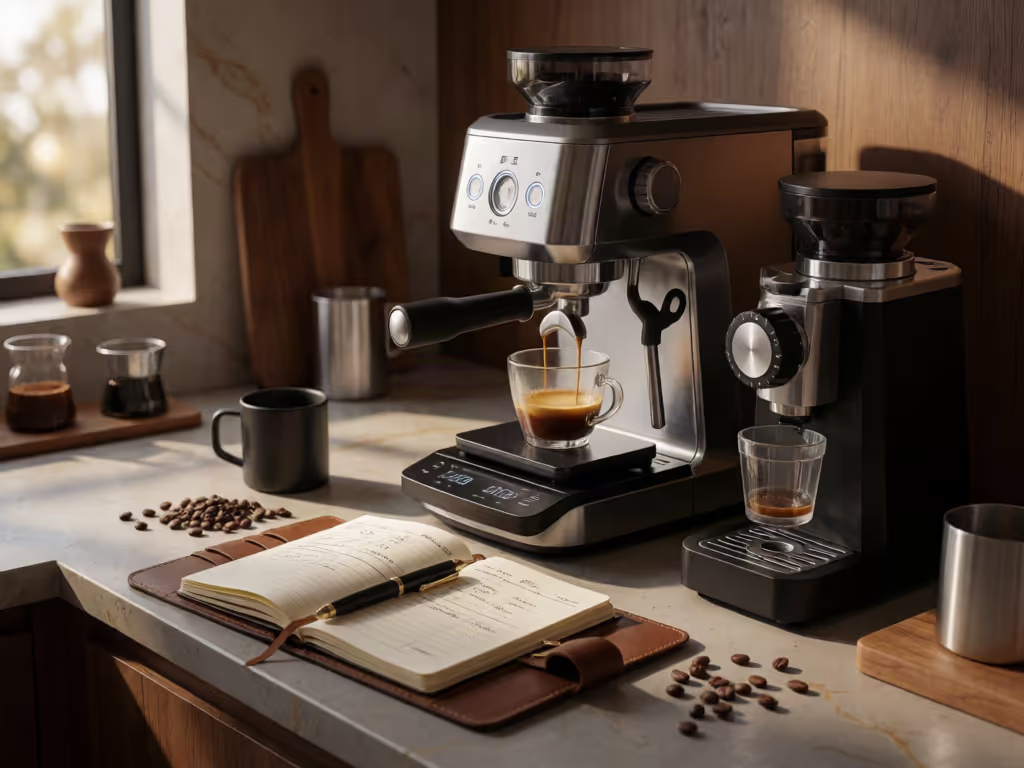
A more disciplined approach is to name buttons by their household recipe where the machine permits it, or maintain a small note beside the grinder:
- Recipe A: dose, target yield, usual timing range
- Recipe B: dose, target yield, usual timing range
- Preset audit: date, beans, grind adjustment, observed result
This reduces ambiguity and makes programmable controls serve the recipe rather than replace it. A simple espresso shot log can make those dose, yield, timing, and taste records easier to review over time.
When a Programmed Button Becomes Unreliable
If a volumetric button suddenly runs continuously, stops unusually early, or varies markedly across repeated shots, do not assume the setting was simply erased. Unexpected behavior can involve the flowmeter, wiring, control board, solenoid, water supply, debris, air, or a sticking internal rotor. If inconsistent results persist beyond the programmed setting itself, consult our guide to troubleshooting bitter, sour, or inconsistent espresso shots.
Avoid improvised internal service. Follow the manufacturer's diagnostic procedure for the particular machine and seek qualified service when required. The useful home observation is the symptom pattern: record what changed, across which button, and whether the issue persists under a stable recipe.
FAQ
Is 18 g of coffee a single or double shot?
There is no universal gram definition supported by the words "single" and "double." An 18 g dose paired with a 36 g beverage yield is a 1:2 example, but the terminology is not universal, and button meanings and control logic are model- and mode-specific.
Is 36 g of espresso always a double shot?
No. A 36 g yield can fit an illustrative 18 g-in, 36 g-out recipe, but it is not a universal definition of a double shot.
What do the different espresso-machine buttons mean?
Their meanings are model-specific. A labeled button may invoke timed, volumetric, or weight-based control. Consult the manual and identify what the selected mode actually uses as its stop signal.
Final Verdict
Espresso machine drink volume programming is most valuable when it automates a recipe you have already measured, tasted, and documented. Traditional volumetric programming offers efficient repetition of a metered-water target; brew-by-weight control targets beverage mass more directly; timed programs repeat duration. None independently guarantees balanced flavor.
The durable method is straightforward: dial in manually, program according to the exact manual, verify final yield on a scale, and recheck whenever the recipe changes. That modest discipline turns programmable espresso shot buttons from a convenience feature into a reliable part of the morning workflow, and prioritizes taste consistency over time.
Related Articles