Espresso Recovery Time: Tested for Back-to-Back Drinks
By Maya Desai • 15th Mar
Espresso machine recovery time is the interval your machine needs to reheat after pulling a shot before the next extraction yields consistent results. For most home single-boiler machines, this window spans 1-3 minutes, though the actual requirement depends on boiler volume, heating power, and your tolerance for temperature drift. If you brew multiple drinks in sequence (say, two cappuccinos before work), understanding recovery mechanics separates a smooth morning from one where shot two tastes nothing like shot one.
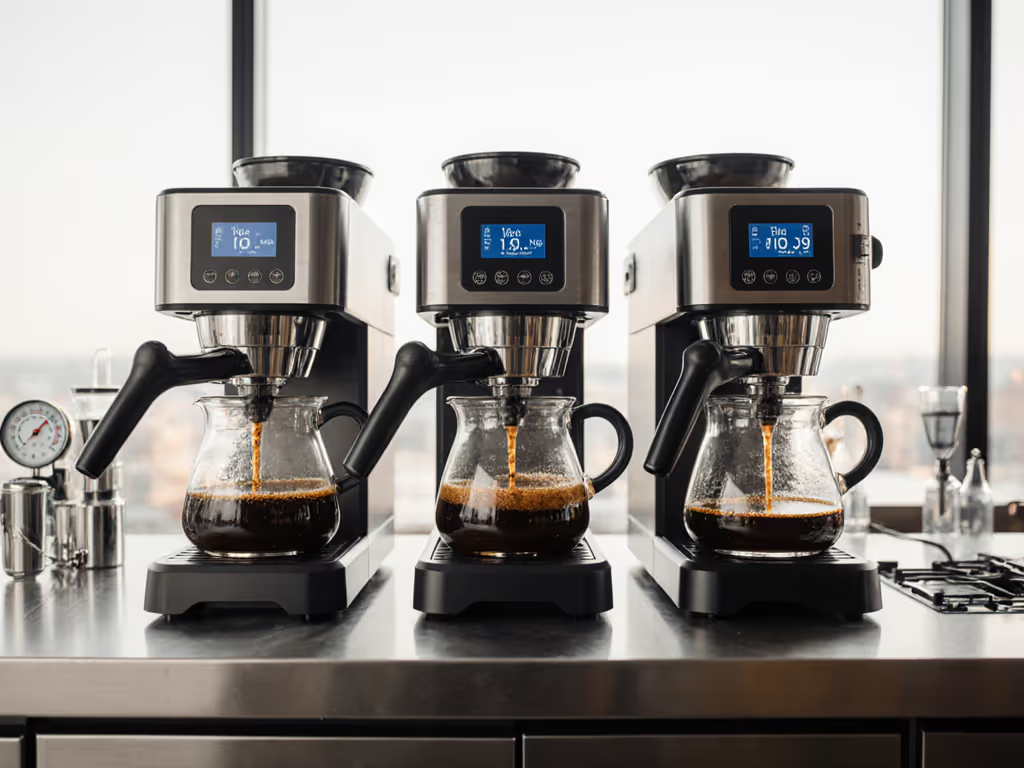
This matters because back-to-back brewing performance is not a luxury; it is a workflow requirement. When the alarm is barely past snooze, consistency beats charisma. That principle drove my own month of 6 a.m. logging sessions, timing temperature curves and extraction weights across two similar machines. One held tight across the session; the other drifted. The gap was entirely rooted in thermal stability between pulls.
What Actually Happens During Recovery?
When you pull a 30-second espresso shot, you introduce a significant volume of cold water from the reservoir into the boiler, causing the temperature to drop 5-15°C depending on machine mass and heating power. Your heating element then engages to climb back to the setpoint (typically 90-94°C for brewing). The time this takes is recovery time.
The key distinction is boiler temperature versus group head temperature. Many home espresso machines display boiler temperature via a PID or analog dial, but the group head (where water actually contacts coffee) sits downstream and often runs cooler, especially on single-boiler machines where brew group and steam group share one thermal mass. A PID reading of 93°C does not guarantee your group head is at 93°C; there is lag. If your machine uses an E61-style group, our E61 group head guide explains why group mass and water path create this lag. This asymmetry explains why some users report dial-up recovery (1-2 minutes by boiler) yet experience inconsistent extractions. The group head is still stabilizing.
Recovery Times in Practice: Real-Home Data
Three scenarios commonly cited in home testing:
-
Blank water flush (no coffee): 25-48 seconds. This minimal load lets the boiler recover quickly because you are not drawing heat through coffee grounds.
-
Light espresso shot (18-20 g in, ~30 seconds extraction): 45-90 seconds. The shot removes thermal energy; recovery depends on boiler mass and heater wattage.
-
Sequential espresso pulls without pause: 2-3 minutes recommended. This assumes a typical 300-400 ml single-boiler machine (1000-1200 W heater). If you pull shot two within 90 seconds of shot one, many users observe a 7-10% weight reduction in the second shot or a faster flow rate, signaling insufficient group head equilibration.
One documented example: a user with a Lelit Victoria (300 ml brass boiler, 1200 W heater) pulled a shot yielding 49 g output; after waiting 11 minutes, the identical grind and extraction time produced only 42 g. The initial diagnosis was recovery failure, but the underlying cause was likely inconsistent puck preparation compounded by thermal lag. The lesson: recovery time alone does not guarantee consistency; puck prep and group head stabilization are equally critical.
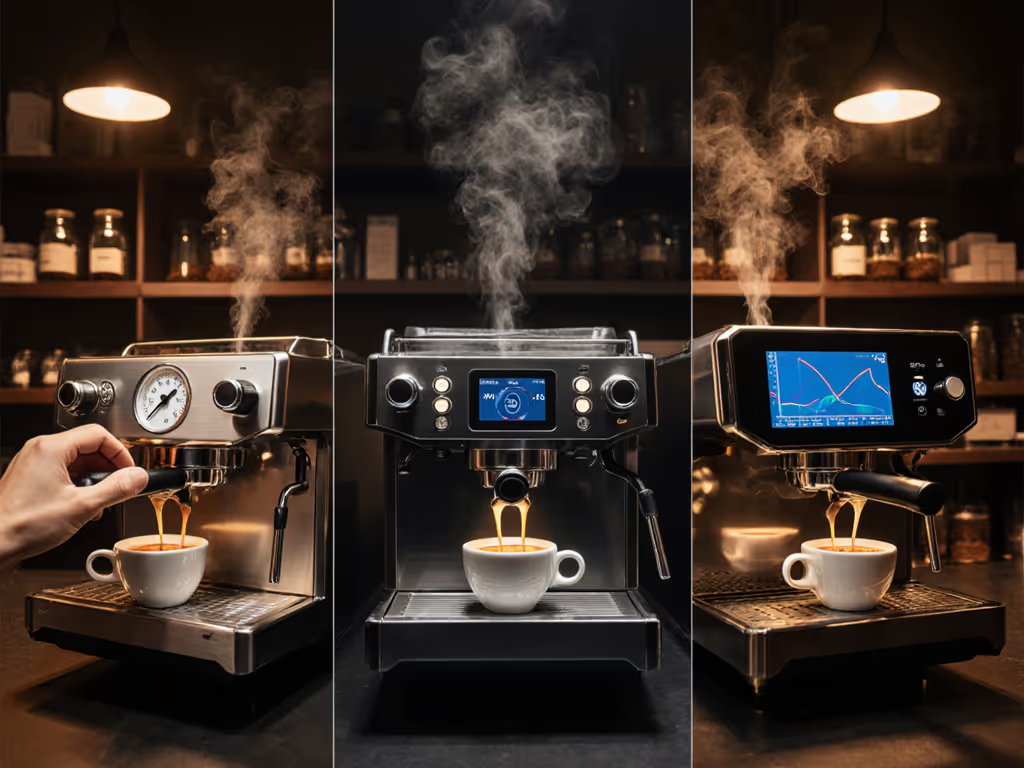
How Single Boiler, Heat Exchanger, and Dual Boiler Machines Differ
Single boiler machines (the most common in the $400-$1200 range) heat one thermal mass for both brewing and steaming. Recovery is slowest here because steaming requires 120-130°C, and after steam purging, the machine cools significantly before you can brew again. Typical recovery: 2-3 minutes.
Heat exchanger machines (e.g., Rancilio Silvia, some Gaggia models) circulate water through a small copper tube inside the steam boiler. The steam boiler stays hot; the internal tube supplies brew-temperature water on demand. Recovery is much faster (often 30-60 seconds) because the steam boiler itself does not cool after a shot. Trade-off: these machines are less forgiving if you miss the thermal sweet spot. For a deeper comparison of HX versus dual boiler behavior, see our HX vs dual boiler guide.
Dual boiler machines ($1500+) maintain separate brew and steam boilers at independent setpoints. Recovery is effectively nonexistent between espresso pulls because each boiler is dedicated. Downside: higher cost, larger footprint, more complexity.
FAQ: Key Questions on Recovery and Workflow
What is the minimum wait time before I can pull shot two?
Workflow-first testing indicates that 60-90 seconds is the practical floor for single-boiler machines if you want shot-to-shot reproducibility within ±5% by weight. However, 2 minutes is the safer target if you are pulling multiple milk drinks back-to-back. This assumes your boiler is already warmed from the morning startup; cold-start recovery is separate (typically 5-8 minutes).
Does the PID display tell me when I am ready to brew again?
Partially. The PID shows boiler temperature, which is useful but incomplete. You are truly ready when the group head has also stabilized (usually 20-30 seconds after the boiler setpoint is reached). Watch the boiler temperature climb back to your target on the display, then wait an additional 30 seconds before dosing. This two-phase rhythm is tedious but yields consistent results.
Can I speed up recovery by adjusting my PID settings?
Yes, within limits. A lower P value (proportional gain) in the PID tuning will make the heater fire longer, reaching setpoint faster, but at the risk of overshoot and temperature instability. If you increase the P value too much, you get oscillation (temperature bounces above and below setpoint, causing inconsistent extractions). A balanced P-D tuning gives stable recovery in 60-90 seconds on most home machines. Consult your machine's manual or community forums for safe starting points; PID tuning is machine-specific.
Why does my second shot taste sour when the first was perfect?
Sour espresso usually signals under-extraction: water moved through the coffee too quickly, picking up acids but not sugars. Common causes include (in order of likelihood):
-
Insufficient recovery time. The group head is still cool; water flows faster than intended, and contact time is too short.
-
Changed grind size. You dialed for the first shot but did not account for the machine's thermal state changing between pulls.
-
Puck preparation variance. Tamping pressure, distribution, or channeling shifted between shots (common when rushing).
-
Pump pressure drift. Rarely, the pump regulator or pressurestat drifts after thermal cycling. Check if your pressure gauge (if installed) reads 8.5-9.5 bar consistently.
Start by extending your wait time to 2 minutes and using consistent puck technique (weighing dose, leveling, tamping with the same force). If sourness persists, suspect grind size or channeling. Work through our espresso troubleshooting checklist to isolate channeling, pressure, or temperature issues fast.
Can I speed up my workflow another way besides waiting?
Yes, three tactics:
-
Use pre-infusion (if your machine supports it). A 5-10 second low-pressure soak before full pressure equalizes the puck and can improve extraction stability even with slightly elevated group head temperature.
-
Pull a blank water flush between shots if you can tolerate the noise. This warms the group and accelerates boiler recovery simultaneously. Recovery after a blank shot is 25-48 seconds versus 60-90 after a full espresso pull.
-
Plan milk drinks around thermal cycles. On a single boiler, pull your black coffee first (fast recovery to boiler temperature), then steam milk (which heats the boiler further). By the time milk is textured, the boiler is over-temperature; let it cool slightly, then pull shot two. This way, the steaming phase is your recovery time. If milk drinks are your priority, use our milk steaming guide for beginners to keep texture consistent while your boiler stabilizes.
The Test Framework: Measuring Your Own Recovery
If you are skeptical (and you should be), run a transparent test on your machine:
Test A: Boiler Recovery
Pull a 30-second espresso shot. Note the PID temperature at the moment flow stops. Watch it drop, then climb back to your setpoint (e.g., 93°C). Time how long from "flow stops" to "PID is back at 93°C." Record three replicates. This is your boiler recovery time, unit: seconds.
Test B: Group Head Recovery
Pull shot one (black espresso, weigh the output). Immediately knock out the puck. Wait exactly 60 seconds. Pull shot two with identical grind, dose, and tamp. Weigh the output. Repeat for 90 seconds, 2 minutes, and 3 minutes. A consistent output weight (within ±2 g) indicates the group head has stabilized; inconsistent output signals you are below the thermal threshold. This is practical recovery time, unit: seconds.
Test C: Pressure Curve
If you own a pressure gauge, record the pre-shot pressure (pump idle) and mid-shot pressure (full flow) for your first espresso and your second espresso (after various wait times). Pressure drift between shots suggests thermal instability affecting pump performance or group resistance.
This workflow-first testing approach removes guesswork. You now have data, not anecdote.
Why This Matters for Your Morning Routine
Most home espresso users brew 1-3 drinks in the morning window. If recovery time is unpredictable or long, the workflow collapses: you either wait (defeating the speed benefit of espresso) or rush and accept inconsistent taste. The users who report satisfaction with their machines are almost always those who built a predictable rhythm: cold start the machine, pull shot one while it finishes heating, wait 2 minutes for recovery (meanwhile grind and dose shot two), pull shot two. No surprises.
Machines optimized for this rhythm (mid-tier heat exchangers and dual boilers) command premium prices because the recovery problem is solved. Single-boiler machines dominate the entry-to-prosumer space ($400-$1200) precisely because they are affordable, but they force you to acknowledge the recovery constraint in your workflow. That constraint is not a flaw; it is a design trade-off. Knowing it, and planning for it, converts frustration into competence.
Summary and Final Verdict
Espresso machine recovery time is a metric-first constraint, not optional. For single-boiler machines, assume 2-3 minutes between shots; for heat exchangers, 60-90 seconds; for dual boilers, negligible. The boiler temperature display on your PID is a guide, not a guarantee (the group head is the actual rate-limiter).
The most reliable path to back-to-back brewing performance is to:
- Wait a minimum of 60-90 seconds on heat exchanger or dual-boiler machines; 2-3 minutes on single boilers.
- Use workflow-first testing: measure your own boiler and group head recovery with the simple tests outlined above. Generic recommendations do not account for your machine's thermal mass, heater power, or altitude.
- Plan milk drinks strategically on single boilers by steaming first, which reheats the boiler while you texture milk, then pulling shot two once the boiler cools slightly back to setpoint.
- Automate puck prep (dose by weight, distribute with a leveler, tamp consistently) so that recovery time is the only variable between shots. Variance in puck prep will mask recovery problems. Sharpen your routine with our advanced puck preparation guide for level distribution and repeatable tamping.
Consistency beats charisma. A machine that yields the same shot every 3 minutes is more valuable on a Tuesday morning than a temperamental machine that shines on weekends. The machines that survive in home kitchens are the ones where recovery is fast, stable, and transparent (and where you have built a rhythm around it). Your gear should serve your workflow, not the reverse.
Related Articles