Outin Nano vs Nanopresso: Portable Espresso Machines Off Grid
By Maya Desai • 14th Sep
Quick verdict
The OutIn Nano is the better choice when you need automatic brewing from room-temperature water; the Wacaco Nanopresso is better when you already have hot water and want a lighter, battery-free setup. Neither is a universal winner.
- Choose the OutIn Nano if: You value self-heating, automatic extraction, and ground-coffee or capsule flexibility more than minimizing weight. Its battery and charging requirements remain part of the travel plan.
- Choose the Nanopresso if: You can reliably supply hot water and prefer 336 g of manual, battery-free equipment over the Nano’s 670 g electric design.
- Main trade-off: The Nano shifts preparation toward charging; the Nanopresso shifts it toward heating water and hand-pumping. Pressure ratings do not establish a taste winner, and direct field testing is limited.
Important: Battery performance varies by conditions: OutIn claims up to five cold-water brews per charge, while one reviewer observed two to three self-heated shots.
The Outin Nano vs Nanopresso decision comes down to one operational question: does your portable espresso machine need to create its own hot water, or can your trip reliably supply it? The OutIn Nano is a rechargeable, self-heating automatic brewer; the Wacaco Nanopresso is a lighter, hand-pumped brewer that requires hot water before extraction. For off-grid portable espresso options, that distinction matters more than the headline 20-bar versus 18-bar figures.
At-a-Glance: The Meaningful Differences
| Metric | OutIn Nano | Wacaco Nanopresso |
|---|---|---|
| Brewing approach | Automatic heating and extraction | Manual pumping after adding hot water |
| Water heating | Yes | No |
| Stated cold-water cycle | 200 seconds for 50 ml starting at 25°C, including heating and extraction | Not applicable; hot water is required |
| Weight | 670 g | 336 g |
| Water capacity | 80 ml maximum; OutIn recommends 50 ml for crema | 80 ml |
| Coffee formats | Ground coffee and capsules | Ground coffee as standard; capsules need separately sold NS Adapter |
| Stated pressure | 20 bar | 18 bar |
| Power dependency | 2,500 mAh 3S rechargeable battery | No battery or electricity for pumping |
Short conclusion:
- Choose the OutIn Nano when carrying a charged device is easier than arranging hot water.
- Choose the Nanopresso when weight, mechanical simplicity, and battery independence matter most, and you already have a dependable way to heat water.
- Do not treat 20 bar versus 18 bar as a taste ranking. Those are manufacturer pressure specifications, not matched extraction results.
The Core Trade-Off: Heat Autonomy vs. Energy Autonomy
OutIn Nano: A portable electric espresso maker with a defined cold-water workflow
The OutIn Nano is built for the moment when you have water but no kettle: hotel room, office, vehicle stop, or a campsite with charging capacity. OutIn states that it heats and extracts using 50 ml of 25°C water in 200 seconds, reaching a stated target of 92°C / 198°F. Once coffee and water are loaded, heating and extraction are automatic, with no hand-pumping phase.
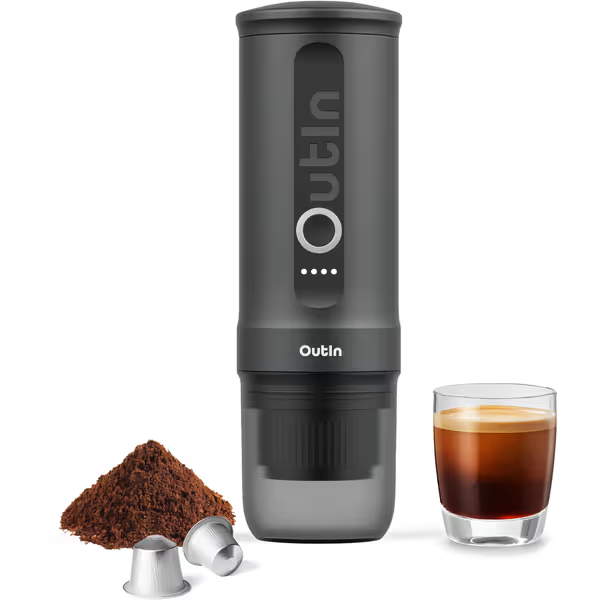
OutIn Nano Portable Electric Espresso Machine
Portable espresso with rich crema, fast heat, and dual compatibility.
$149.99
Weight670 grams
Weight670 grams
Pros
Fast self-heating for quick shots
20-bar pressure ensures rich crema
Compatible with ground coffee and capsules
Cons
Limited hot shots per battery charge
Airline travel restrictions apply
That is the Nano's practical advantage. A routine has fewer dependencies: coffee, water, a charged brewer, and a cup. OutIn lists an 80 ml maximum water mark but recommends 50 ml for optimal crema. The company also states compatibility with both ground coffee and capsules, which can reduce packing decisions when a grinder is not part of the trip.
Battery numbers require careful reading. OutIn claims up to five cold-water brews per charge under its specified 50 ml, 25°C starting condition, and over 200 brews when beginning with hot water. Those are manufacturer figures, not a promise for every temperature, recipe, battery condition, or environment. One independent reviewer instead observed 2-3 self-heated shots per charge. The two figures are not directly reconciled by the available evidence, so plan conservatively if self-heating is essential rather than building a multi-day camping espresso setup around a maximum claim.
Charging is another workflow constraint. OutIn says the Nano should not be used while charging and specifies 5 V / 3 A (15 W) charging in its FAQ. Treat 15 W as the conservative requirement: the manufacturer's product materials contain a lower charging threshold elsewhere, without fully resolving the difference.
Consistency beats charisma when the alarm is barely past snooze.
For a traveler who values a repeatable button-led sequence, the Nano has the clearer process. But "off grid" does not mean "without planning": its self-heating benefit shifts the preparation burden to battery management.
Nanopresso: A manual portable espresso maker built around an existing heat source
The Wacaco Nanopresso reverses that logic. It weighs 336 g, almost half the Nano's 670 g, and measures 62 × 71 × 156 mm. It requires neither battery power nor electricity to generate extraction pressure. Instead, you fill it with hot water, then pump by hand.
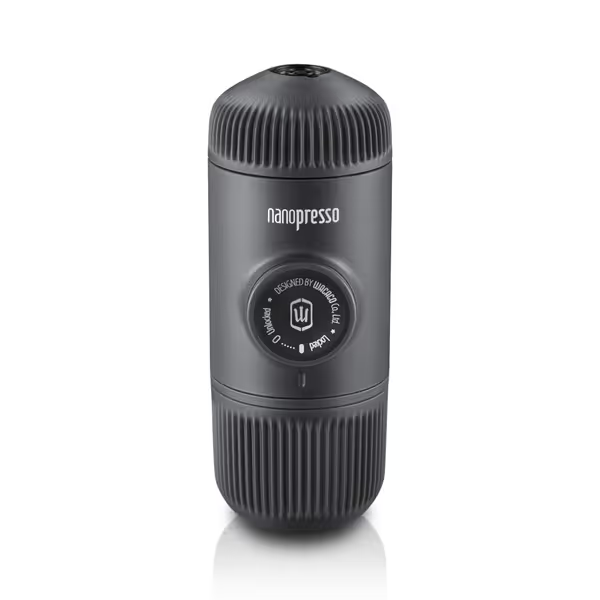
WACACO Nanopresso Portable Espresso Maker
Portable, manual espresso for cafe-quality shots anywhere, anytime.
$61.97
Max Pressure18 Bar
Max Pressure18 Bar
Pros
Enjoy rich espresso with crema on the go.
No electricity needed; fully manual operation.
Fast, simple cleaning after each use.
Cons
Requires separate hot water source.
Accessories (like Nespresso adapter) sold separately.
Wacaco is explicit that the Nanopresso does not heat water. This is not a small caveat; it is the device's defining requirement. If your camp stove, insulated flask, cabin kettle, or travel boiler is already part of the kit, the manual design eliminates charging and self-heating wait time at the brewer. If no hot-water plan exists, the Nanopresso cannot produce hot espresso on its own.
Its standard configuration uses an 8 g ground-coffee basket and a pressurized portafilter. Wacaco recommends extra-fine coffee and firm tamping. That makes preparation quality consequential: pre-ground coffee may be the simpler travel choice, while a compact grinder adds control but also time and gear. A separately sold NS Adapter is required for Nespresso Original and many compatible capsules; capsule use is not included in the standard setup.
The pumping effort is tangible rather than theoretical. Wacaco specifies up to 18 bar and says reaching that condition requires a stated 13 kg / 28.66 lb of force, recommending a two-handed hold. The number does not mean you will sustain identical force during every second of every shot, but it accurately frames the trade: mechanical independence asks for manual input.
What "Off Grid" Actually Means in Your Routine
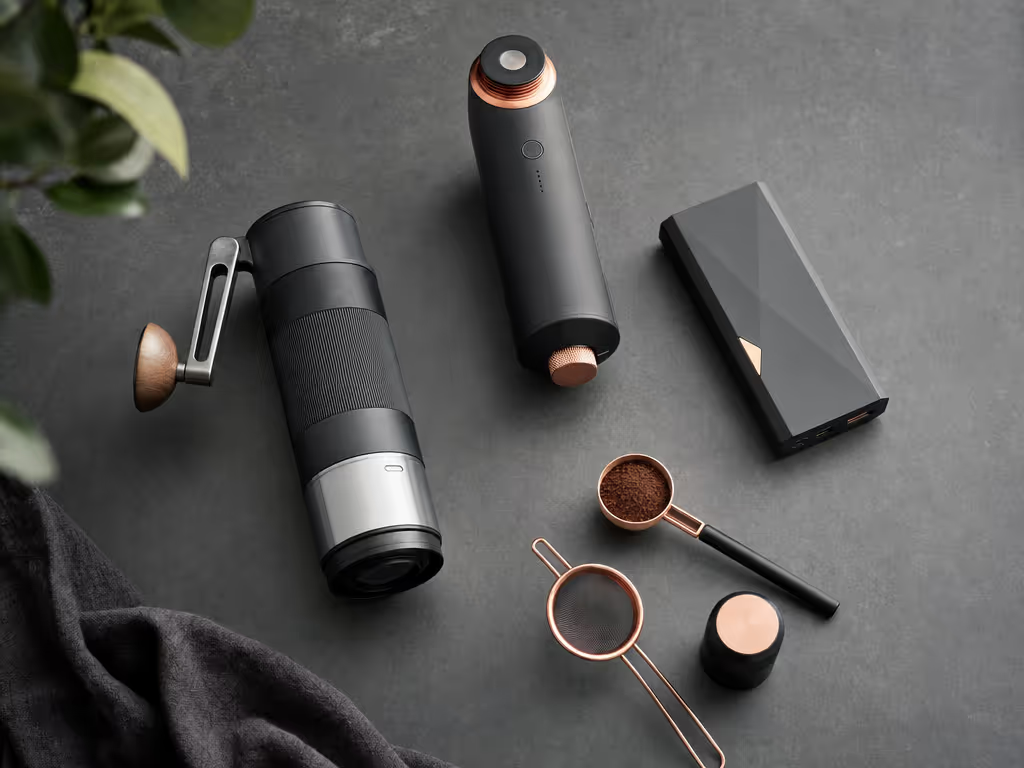
A useful comparison starts by listing the resources available at the brew site, not by declaring one machine the best coffee maker for every traveler.
Scenario 1: You have water, but no reliable way to heat it
Nano advantage. The self-heating cycle directly solves the missing-kettle problem. OutIn's stated 200-second cycle applies only to 50 ml beginning at 25°C, so colder conditions or different use may change that result. Still, it is the only one of these two machines designed to heat its own water.
The constraint is power. Charge before leaving, bring a compatible power source where possible, and avoid assuming the maximum manufacturer-rated cold-water cycles will be your result.
Scenario 2: You have a stove or reliably hot water, but limited pack weight
Nanopresso advantage. At 336 g, it weighs 334 g less than the Nano. You trade that weight reduction for a separate hot-water tool and manual pumping. For travelers who already boil water for meals or tea, that can be a coherent system rather than extra work.
Scenario 3: You want the lowest-effort single espresso at a desk, hotel, or stopover
Nano advantage. Automatic heating and extraction, plus ground-or-capsule compatibility, simplify the steps after loading. It is the more workflow-first testing choice when "make coffee before the next meeting" is the operating condition.
Scenario 4: You want a battery-free backup
Nanopresso advantage. There is no charge state to monitor for extraction. The caveat remains fixed: battery-free does not mean heat-free. Pack the hot-water solution first, then count the Nanopresso as the espresso component.
Taste, Pressure, and Repeatability: What the Numbers Can and Cannot Tell You
Both machines advertise high pressure - 20 bar for the Nano, 18 bar for the Nanopresso - but those values do not establish a direct cup-quality winner. Pressure is only one part of extraction, and the available evidence does not include a controlled, like-for-like tasting or extraction comparison of the standard configurations. For a broader framework on adjusting dose, yield, time, and grind size, see this guide to dialing in espresso.
There is one useful, limited data point: in a portable-maker comparison, Coffee Chronicler assigned the OutIn Nano a 4 for shot quality and the Nanopresso a 2 in its own scoring table. That is one reviewer's judgment, not an industry-standard measurement or a universal result. The same reviewer considered the Nanopresso a decent option for users without a dedicated espresso grinder because it uses a pressurized portafilter.
My read is deliberately narrow:
- The Nano has a more automated thermal workflow and a higher single-reviewer shot-quality score.
- The Nanopresso makes the user responsible for water temperature, pumping, grind, and tamp execution.
- Neither statement proves that every Nano shot will beat every Nanopresso shot.
During a month of 6 a.m. testing on two similar home machines, I learned how quickly a promising first shot can become midweek drift when the process leaves too much to changing inputs. Portable tools amplify that effect: water temperature, coffee freshness, dose preparation, and human effort are all less controlled away from the kitchen. If predictable taste is your priority, reduce variables before you leave, portion coffee, decide whether you will use grounds or capsules, and settle the water/charging plan in advance.
Cleanup and Ownership Limits
The evidence supports a clearer maintenance description for the Nanopresso. For maintenance tasks tailored to different espresso technologies, consult this guide to espresso machine maintenance by type. Wacaco directs users to wash specified removable components under running water and dry pieces separately; it says the machine is not dishwasher safe. Its portafilter components can be separated for deeper cleaning.
The available information does not support a matched claim that one is faster or easier to clean outdoors. Nor is there sufficient evidence here to rank long-term durability, weather resistance, repairability, replacement-part availability, or battery longevity for either model. If those are deciding factors, verify current support options directly before purchase.
For air travel, OutIn's own guidance is carry-on only and no in-flight use. Treat that as manufacturer direction, not a blanket airline approval: even generally permitted items may receive additional screening or be disallowed at the security checkpoint.
FAQ
Do portable espresso machines heat the water?
Some do, some do not. In this comparison, the OutIn Nano is designed to heat 50 ml of 25°C water to a stated 92°C and extract in 200 seconds under manufacturer test conditions. The Wacaco Nanopresso does not heat water; it needs hot water added before brewing.
Is the OutIn Nano worth it?
It is a sensible fit if self-heating and automatic extraction solve a real travel problem for you. Its value case is weaker if you already heat water easily and would rather carry 334 g less equipment with no battery dependence. Battery-shot expectations should remain conservative because a reviewer's 2-3 self-heated-shot observation differs from OutIn's up-to-five claim under stated conditions.
Are portable espresso machines any good?
They can be useful when matched to the right constraints. These two models are not substitutes for one another: one prioritizes self-contained heating, while the other prioritizes lower mass and manual, battery-free operation. A good result still depends on water, coffee preparation, and choosing a workflow you can repeat.
Final Verdict: Pick the Dependency You Prefer
For the Outin Nano vs Nanopresso matchup, the winner is conditional rather than absolute.
Buy the OutIn Nano if:
- You need a portable electric espresso maker that can start with room-temperature water.
- You prefer automatic heating and extraction over pumping.
- You can charge before departure and accept that self-heating runtime varies by conditions.
- You want ground coffee or capsule flexibility in the standard machine.
Buy the Wacaco Nanopresso if:
- You already carry or can reliably obtain hot water.
- You value the lower 336 g weight and battery-free operation.
- You accept manual pumping as part of the ritual.
- You want a compact manual portable espresso maker with an 8 g pressurized ground-coffee basket.
The Nano is the stronger answer to "espresso wherever I am, even without a kettle." The Nanopresso is the stronger answer to "I have hot water; keep my pack light and my system independent of charging." Choose the one whose constraints your trip already solves, not the one with the more impressive-looking pressure number.
Related Articles