Breville Barista Express Espresso Maker vs Barista Pro Comparison
By Aisha Khan • 16th Nov
Quick verdict
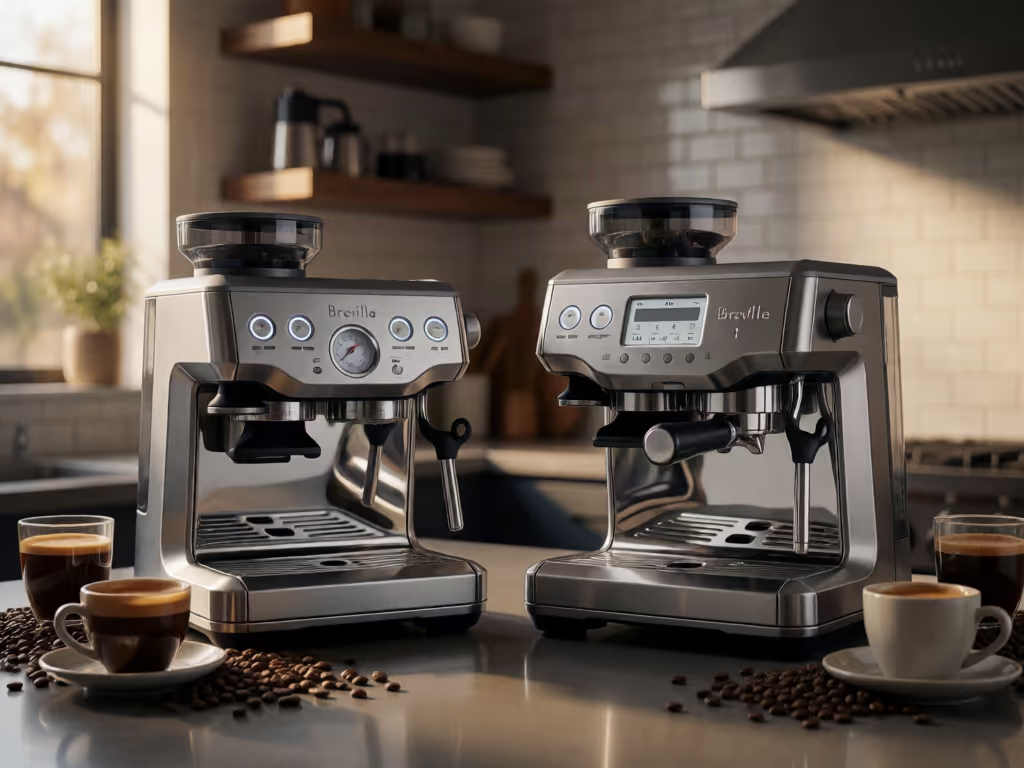
The Barista Pro is the stronger choice when faster starts and on-machine guidance matter; choose the Barista Express when its documented built-in grinder, manual steam wand, and hot-water spout meet your needs. The documented difference is workflow, not proven cup quality.
- Choose the Barista Express if: You value a straightforward all-in-one setup with a built-in burr grinder, manual steam wand, and hot-water spout, and your routine allows time for hands-on preparation. View on Amazon
- Choose the Barista Pro if: You want a claimed three-second heat-up, faster espresso-to-steam workflow, and an LCD that displays grinding and extraction progress.
- Main trade-off: The Pro’s advantages are retailer-listed claims and interface features, not independently verified improvements in taste, noise, reliability, or long-term value.
Important: Exact maintenance guidance, current pricing, and a reliable Barista Express heat-up time were not established, so verify those factors before deciding.
Choosing between the Breville Barista Express espresso maker and the Barista Pro is less about chasing a "better" machine and more about protecting your morning. Both model families are positioned as hands-on, built-in-grinder routes to home espresso. The meaningful documented case for the Pro centers on faster-start workflow and LCD progress animations. If your usual morning has one person packing lunches, another joining a meeting, and coffee needs to happen without a lengthy warm-up ritual, that distinction can matter more than headline specs.
The comparison needs one important boundary: the available product detail is much stronger for the Barista Pro BES878BSS than for the Barista Express BES870 family. So this guide focuses on what can be responsibly compared. The Express family is described with a built-in burr grinder, manual steam wand, and hot-water spout. The Pro BES878BSS has an LCD that displays grinding and extraction progress, and a retailer guide attributes its faster heat-up and steam times to ThermoJet technology. It does not assume unverified differences in cup quality, grinder range, noise, durability, or cleanup.
Step 1: Start With the Decision That Actually Changes Your Day
Before comparing buttons or finishes, answer one question:
Do the Pro’s speed claims and on-machine progress display matter to your weekday routine, or do the Express’s documented core tools meet your needs?
One retailer guide describes the Barista Express as an introductory model with a burr grinder, a manual steam wand, and a hot-water spout. That is a coherent setup for someone who wants to learn espresso without buying a separate grinder immediately.
The Barista Pro follows the same broad all-in-one idea, but its documented features center on heat-up speed and on-machine progress information. It uses a ThermoJet system said to reach its stated extraction temperature in three seconds, and the move from espresso to steam is described as instantaneous. Those are claims rather than independently timed results, but they are still relevant signals if your problem is a disrupted 7:42 a.m. routine rather than a lack of interest in espresso craft. For more context on how different heating technologies affect warm-up speed and brewing routines, compare thermoblock and heat exchange systems.
The quick choice
- Choose the Barista Express if you want an all-in-one setup with a built-in burr grinder, manual steam wand, and hot-water spout.
- Choose the Barista Pro if faster-start claims, switching to milk drinks, or seeing grinding and extraction progress on an LCD address the friction points that matter to you.
- Pause before buying either if quiet operation, dry-puck behavior, splash control, repair turnaround, or exact maintenance requirements are deciding factors. The available evidence does not establish a winner on those issues.
I have watched a 'fancier' machine lose the weekday test in a household with two kids, one meeting, and eight minutes to spare (not because it made bad coffee, but because it created too many tiny decisions and too much wiping). Workflow, not wattage, sets the tone.
Step 2: Compare the Shared Hands-On Espresso Workflow
Both machines are presented as hands-on espresso options with built-in grinders and manual steam wands. The available comparison material describes the Barista Express with a burr grinder, manual steam wand, and hot-water spout; the Barista Pro listing describes an integrated precision conical-burr grinder and a manual microfoam steam wand.
For the Barista Express family, there are three useful core tools:
- Built-in burr grinder for grinding beans at the machine.
- Manual steam wand for user-controlled milk texturing.
- Hot-water spout for hot water alongside espresso-making duties.
The Barista Pro BES878BSS listing describes an integrated precision conical-burr grinder with adjustable settings, a manual microfoam steam wand, and 1- or 2-cup volumetric controls. It also uses digital temperature regulation stated at ±2°C.
The Pro is not trying to replace your judgment. Its LCD displays grinding and extraction progress while the coffee preparation and milk texturing remain hands-on. It does not prove that the Pro will make better-tasting espresso than the Express in every kitchen, with every bean, or for every skill level.
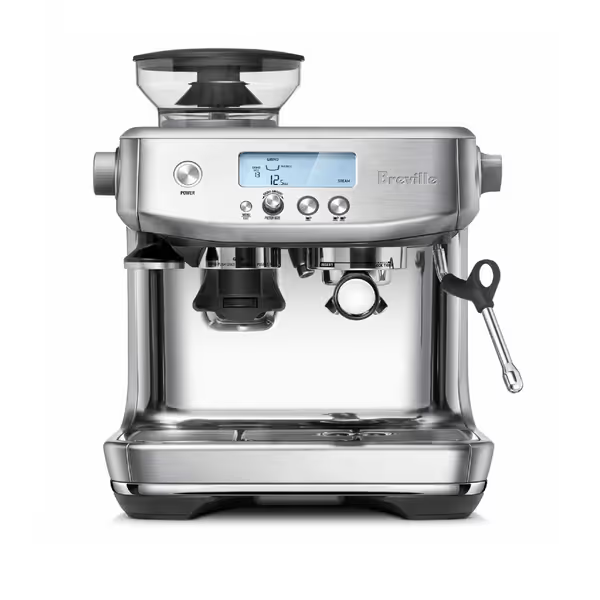
Breville Barista Pro Espresso Machine BES878BSS
Cafe-quality espresso at home with integrated grinder and fast heat-up.
$849.95
Heat-up Time3 seconds
Heat-up Time3 seconds
Pros
Integrated grinder for bean-to-espresso in under a minute
Fast ThermoJet heating system for instant use and steam
Intuitive LCD display simplifies brewing and extraction
Cons
Some report issues with machine longevity
Coffee temperature can be inconsistent for some users
Customers praise its ease of use, quick brewing, and value, though some note inconsistent coffee warmth and functional issues.
Customers praise its ease of use, quick brewing, and value, though some note inconsistent coffee warmth and functional issues.
What this means for a first-time buyer
If your search history includes "espresso coffee grinder manual," you may be looking for a machine that gives you some structure while leaving room to learn. The Pro's LCD is one documented feature to consider. It displays grinding and extraction progress animations, so you can see those stages on the machine.
The Express remains a comparison candidate if its documented grinder, manual steam wand, and hot-water spout cover your priorities. The available material does not support saying that one integrated grinder is more precise, more adjustable, or easier to dial in than the other, so do not let that unsupported claim decide the purchase.
Step 3: Put the Warm-Up Difference on Your Actual Timeline
For a milk-drink household, the important question is not "Which machine is more powerful?" It is: Where does waiting appear in the routine?
Here is a practical way to map it.
A weekday sequence to picture
- 7:30 - Turn on the machine.
- 7:31 - Fill a glass of water, find a cup, or start breakfast.
- 7:33 - Grind and prepare coffee.
- 7:35 - Pull espresso.
- 7:36 - Steam milk.
- 7:38 - Wipe the work area and leave the kitchen.
The Barista Pro's three-second heat-up claim and one retailer guide's description of faster heat-up and steam times are directly relevant to this kind of sequence. If the machine is ready when you are, rather than becoming another timer to manage, it can make manual espresso feel manageable before work.
There is no reliable heat-up time provided for the Barista Express, so this guide cannot give you a fair minute-by-minute gap. It also cannot promise that the Pro will finish two milk drinks within a specific total time. Use the Pro's speed claims as a reason to investigate it, not as a guarantee for your kitchen.
If-then guidance
- If you make mostly straight espresso after the machine has already been on, the Pro's faster-start proposition may matter less.
- If you regularly go from espresso to steamed milk in a narrow window, the Pro's claimed immediate espresso-to-steam transition is more compelling.
- If you make coffee only on slow weekends, either workflow may feel perfectly reasonable; the display and speed benefits are less likely to be decisive.
Step 4: Decide Whether the Pro’s LCD Will Help You, or Simply Be Nice to Have
The Barista Pro BES878BSS has an LCD with grinding and extraction progress animations. A retailer comparison guide also describes the Pro as having a digital display.
For a new home barista, that can be more valuable than it sounds. A display does not make decisions for you, but the Pro's LCD shows grinding and extraction progress animations. That puts information about those stages on the machine while you make coffee.
For an experienced person who already works from a stable routine, the screen may be a convenience rather than a need. Manual espresso is still manual espresso. You will still need to pay attention to coffee preparation and milk texturing.
A low-stress setup checklist
Choose the Pro's on-machine display when these statements sound familiar:
- "I want grinding and extraction progress shown at the machine, not a note on my phone."
- "I make coffee before I feel fully awake."
- "More than one person will use this machine."
- "I want grinding and extraction progress displayed without turning coffee into a technical project."
Choose the Express's documented core setup when these sound more like you:
- "I enjoy the tactile routine and want the basic tools in one unit."
- "I am comfortable learning through repetition."
- "I do not need grinding and extraction progress shown on an LCD."
Less fiddling, more sipping. Your morning deserves frictionless espresso.
Step 5: Check Counter and Capacity Fit Before You Commit
For the Barista Pro BES878BSS, the listing reports a 67-fluid-ounce water tank, a half-pound bean hopper, and a U.S. electrical rating of 120 V and 1680 W. Reliable dimensions for this exact unit were not established.
Measure with the workflow in mind, not just the machine's rectangle:
- Leave room to access the hopper and water tank in your particular cabinet layout.
- Reserve a landing zone for the portafilter, milk jug, and a towel.
- Confirm the outlet and voltage match the version you are considering; the listed 120 V specification applies to the U.S. version, not every regional machine.
Reliable matching dimensions and capacities for the Barista Express BES870 family were not provided. Do not assume the machines have identical clearance needs simply because they serve a similar purpose.
Step 6: Do Not Let Unproven "Performance" Claims Choose for You
This is where comparison articles often become too confident. There is no independent hands-on testing presented for espresso taste, steam strength, temperature behavior across multiple drinks, noise, mess, reliability, or long-term repairability. There is also no verified current price comparison.
That means a sensible purchase decision separates documented feature differences from questions you should personally verify.
Documented reasons to lean Pro
- ThermoJet-based fast-start claim: stated extraction temperature in three seconds.
- Described immediate transition from espresso to steam.
- LCD guidance for grinding and extraction.
- Integrated conical-burr grinder with adjustable grinding.
- Manual steam wand and 1- or 2-cup volumetric settings.
Reasons to keep the Express in the running
- It provides the foundational all-in-one format: built-in burr grinder, manual steam wand, and hot-water spout.
- Those documented tools may be all you need if your routine has breathing room.
- Nothing in the available evidence proves a universal taste upgrade from Express to Pro.
Questions to verify before checkout
Ask the retailer or manufacturer about the exact unit you are considering:
- Current warranty terms and local service options. The Amazon listing for the BES878BSS reports a two-year limited product warranty, but eligibility and terms should be confirmed before purchase.
- Counter-clearance requirements in your cabinet setup.
- Official cleaning and descaling instructions.
- Parts availability and authorized repair options in your area.
- Return policy, because noise and ergonomics are felt at home, not on a specifications page.
Step 7: Match the Machine to Your Morning, Not Your Aspirational Hobby Self
Here is the plain-language verdict.
Buy the Barista Pro if speed and guidance are your bottlenecks
The Pro is the better fit when you want an integrated Breville coffee espresso machine that can get moving quickly and show you what it is doing. Its documented case is not "more cafe-worthy coffee by default." Its case is retailer-claimed faster heat-up and steam times, LCD progress animations, and a hands-on manual steam wand.
Buy the Barista Express if its core manual format matches your priorities
The Express family still gives you the essential learning platform: grinder, manual wand, and hot-water spout. For a buyer who makes time for coffee and wants a straightforward entry into hands-on espresso, that may be enough.
The best machine is the one that disappears into a reliable sequence: beans, cup, milk if wanted, quick reset, out the door.
Frequently Asked Question
How long does the Barista Express take to heat up?
A reliable heat-up time for the Barista Express is not available in the material used for this comparison. The Barista Pro claims a three-second ThermoJet heat-up to its stated extraction temperature, and one retailer comparison guide describes the Pro as having faster heat-up and steam times than the Express. That supports the direction of the difference, not a verified minute count for the Express.
Continue Your Comparison With a Real-Kitchen Test
If the Barista Pro sounds right, look up the exact BES878BSS and then compare it with the Barista Express using your own non-negotiables: cabinet clearance, first-cup timing, milk-drink frequency, cleaning instructions, and local support. If possible, practice the imagined 7:30 to 7:40 sequence before you buy.
A machine should earn its counter space by making the busy version of your morning calmer, not by asking you to become a different kind of coffee person first.
Related Articles