La Pavoni Professional Review: Lever Espresso Buying Guide
By Maya Desai • 11th Oct
Bottom line
The La Pavoni Professional PC-16 is best understood as a skill-building manual lever machine, not a low-effort route to uniform weekday espresso.
- Best for: Buy it for a deliberate one- or two-cup ritual involving grind, dose, tamp, lever technique, and heat management. View on Amazon
- Skip it if: Choose a specific pump machine instead if you prioritize fast, repeatable drinks with minimal decisions or frequent back-to-back milk beverages.
- Main limitation: The gauge shows boiler pressure, not pressure at the coffee puck. Sequential shots may require cooling, and refilling a pressurized boiler requires a defined shutdown and steam-release procedure.
Important: Published specifications conflict on some details, and no controlled comparison with a named modern pump machine establishes superior consistency, throughput, or steaming performance.
This La Pavoni Professional review evaluates the PC-16 as a hands-on home lever machine rather than treating it as a conventional push-button appliance. For buyers using a La Pavoni Professional buying guide to escape conflicting claims, the central fact is simple: this model asks the operator to control the extraction lever, grind, dose, tamp, heat, and pace. It can suit a deliberate espresso ritual; it is not the evidence-backed choice for anyone whose priority is identical results with minimal morning intervention.
The La Pavoni Professional PC-16 is a chrome-base, manual lever espresso machine with a listed 38 fl oz boiler, a boiler-pressure gauge, and one- and two-cup filters. Its appeal is direct mechanical participation. Its cost is that the operator (not a programmed pump profile) must create repeatability.
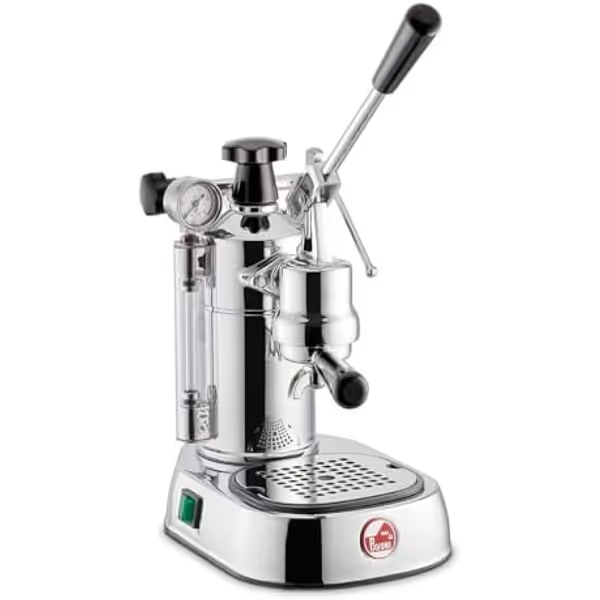
La Pavoni PC-16 Professional Espresso Machine
Master authentic espresso with this professional 16-cup lever machine.
Capacity16-Cup
Capacity16-Cup
Pros
Produces excellent, authentic espresso shots
Classic Italian design with chrome finish
Robust brass boiler for stability
Cons
Significant learning curve for mastery
Reports of frothing system issues
Customers praise its excellent espresso but highlight a significant learning curve.
Customers praise its excellent espresso but highlight a significant learning curve.
Comparative conclusion at a glance
The meaningful comparison is not between two nearly identical machines. It is between two workflows: a manual lever process and a more automated pump-driven process. This guide does not present a controlled, model-specific lab comparison for temperature stability, shot consistency, steam speed, noise, or throughput. The practical distinctions below therefore describe workflow and control, not lab rankings.
| Decision criterion | La Pavoni Professional PC-16 | Pump-driven home-machine workflow |
|---|---|---|
| Extraction control | The user raises the lever to admit water, then lowers it to extract. | The machine typically supplies the pumping action after the brew control is engaged. |
| Main repeatability burden | Grind, dose, tamp, lever feel, heat, and pacing remain operator-managed. | More of the water-delivery action is automated; results still depend on coffee preparation and machine design. |
| Built-in gauge | Indicates boiler/operating pressure, not pressure at the coffee puck. | Gauge function varies by model and should not be assumed. |
| Consecutive drinks | An independent review advises cooling after two or three shots if the group becomes too hot. | Cannot be ranked here without model-specific testing. |
| Refill routine | A pressurized boiler requires shutdown, unplugging, steam release, and slow cap opening before refilling. | Tank layout and refill method vary by machine. |
| Best fit | The buyer who wants to learn a manual lever workflow and accepts variation while refining it. | The buyer seeking a more automated weekday routine should compare specific pump models using measured tests. |
Consistency beats charisma when the alarm is barely past snooze.
That does not diminish the PC-16's purpose. It clarifies it. A traditional espresso machine can reward attention, but the buyer should not mistake manual involvement for automatic precision.
What the PC-16 actually gives you
A lever, not a programmed extraction profile
The defining mechanism of this La Pavoni lever espresso machine is explicit in its operation: raise the lever to fill the brewing chamber, then lower it to deliver coffee. For a deeper explanation of the mechanics and learning curve, see our lever espresso technique guide. The machine's instructions also direct users to modify grind and tamp according to flow and resistance at the lever. Fine grinding and consistent dosing are part of the expected preparation routine.
This is useful control only if you want to exercise it. A changing coffee, a different dose, or altered tamp can be met with a different preparation approach and close attention to how the lever feels. Conversely, the same variables make it easier for a rushed operator to introduce drift from one day to the next.
The manual describes learning the machine as necessary for consistent espresso, and an independent review likewise characterizes the learning curve as steep. That assessment aligns with the mechanism: there is no basis here to promise reliable first-week shots simply because the machine has a pressure gauge or a premium-looking metal exterior.
Read the gauge correctly
The mounted gauge is valuable for monitoring boiler operation. The manual instructs the user to wait for the green zone before brewing or steaming, and says boiler pressure should top out at 0.7-0.8 bar and not exceed 1 bar.
However, this is not an extraction-pressure gauge. It does not show pressure at the group head or coffee puck. That distinction matters when diagnosing a fast, slow, bitter, or weak shot: use the gauge to confirm the boiler's operating state, then use this espresso dialing-in guide to evaluate coffee preparation and lever operation separately.
For a purchaser who wants numerical feedback during extraction, that limitation should be treated as fundamental rather than minor.
La Pavoni Professional performance under a home routine
Heat-up, shot pacing, and thermal discipline
The manual's stated time to maximum pressure is approximately 6-7 minutes. Actual warm-up can vary with fill level and conditions, so this is a procedural guide rather than a guaranteed door-to-cup time.
A more important constraint is sequential-shot management. One independent reviewer advises that the brew group can become too hot after two or three shots and that the machine should be switched off to cool. This is not a manufacturer-rated production limit, but it is useful practical guidance for homes serving several drinks in succession.
In a month of 6 a.m. testing on two superficially similar machines, the revealing difference was not whether either could produce a memorable Saturday shot. It was whether that shot held together through a normal workweek. The PC-16's variables are sufficiently exposed that a buyer should plan around them: stabilize the grinder setting, dose consistently, use a repeatable tamp, and avoid treating a run of drinks as if the group's heat state were unchanged.
The manual also says not to use two lever pulls for one dose of coffee. If you need a different beverage volume, revise the basket and dose workflow rather than simply drawing more water through the same puck. The stated output references are approximately 1-1.4 fl oz for the one-cup filter and 2.5 fl oz for the larger filter, subject to preparation and operation.
Milk drinks: two approaches, one manual workflow
The PC-16 provides a standard steam tube and a Cappuccino Automatic attachment, giving owners two frothing methods. With the standard steam arm, the manual estimates 15-20 seconds per 10 oz cup for frothing. Milk type and technique will affect the real result, so this is best understood as a planning estimate rather than a promised steaming benchmark.
For households making one milk drink at a time, the choices are straightforward: use the steam arm for hands-on texturing or the automatic attachment for a different frothing approach. Beginners can improve the hands-on option with this milk steaming and latte art guide, which covers temperature, pitcher technique, and texturing practice. For a household that routinely makes multiple milk drinks before work, the lack of comparative steaming and recovery tests means the responsible conclusion is narrower: do not buy the PC-16 on an assumed high-volume milk-drink capability.
What "16-cup" does and does not mean
Some retail naming uses "16-cup," but that should not be translated into a guaranteed number of espresso shots per boiler fill. The reliable specification is the 38 fl oz boiler listed in the Professional manual and supporting retailer material. Actual drink count changes with dose, beverage size, steaming, flushing, and operating habits.
For purchase planning, assess the PC-16 as a single- or two-cup-at-a-time machine, not as a numerical promise of how many drinks it will serve before attention is required.
Ownership friction: space, refill safety, and maintenance
Countertop fit and electrical check
The manual lists the PC-16 at 11 in L × 7 in W × 12 in H. Measure for more than the footprint: the boiler cap needs room above the machine for access, although no exact clearance requirement is established here.
For the US-oriented configuration described in the manual, electrical data are 110 V, 60 Hz, and a 1000 W heating element. Regional versions may differ. Buyers outside that context should verify the electrical specification of the exact unit offered for sale rather than extrapolating from the US manual.
Cleaning is routine, not optional
The after-use tasks are specific. Because lever machines have different care requirements from pump and automatic models, our espresso machine maintenance by type guide can help you build an appropriate routine. The instructions call for cleaning the filter handle, filters, coffee press, measuring spoon, and drip basin, plus wiping the group and steam tube. This is not a machine that hides the work behind an automated rinse cycle; it expects the owner to finish the session properly.
Descaling guidance deserves a careful reading. The Professional manual says to repeat its cleaning/descaling procedure four to five times per year depending on use. A retailer's category-level guide for classic La Pavoni levers instead recommends basing descaling on water, inspection, performance, and the manufacturer's procedure rather than the calendar alone. These positions are not fully aligned.
The practical resolution is conservative: follow the procedure for your exact model and production year, and account for your water and machine condition rather than treating any generic interval as permission to ignore deposits. The same category-level guidance says classic La Pavoni manual lever groups should not be backflushed like an E61 pump machine, because they lack the pump-driven three-way solenoid system used in that workflow.
Boiler refill is a safety procedure
Some espresso machines use a removable cold-water reservoir. The PC-16's boiler requires another routine. When refilling a machine that is operating or pressurized, the manual requires that you:
- Switch the machine off.
- Unplug it.
- Release steam through the steam tube.
- Only then slowly open the boiler cap and add water.
The boiler, group, portafilter, and steam surfaces can be hot. This procedure is not a detail to learn later; it is part of the ownership model. A buyer who wants effortless mid-session refills should weigh it heavily.
Who should buy the La Pavoni Professional?
Buy it if your priorities are skill and direct feedback
The PC-16 is a credible choice when you can answer "yes" to most of the following:
- You want a true manual lever process, not a machine that largely automates extraction.
- You accept a substantial learning period for grind, dose, tamp, heat management, and lever technique.
- You generally prepare one or two drinks at a time and can pace consecutive shots thoughtfully.
- You can give cleaning, descaling, and safe boiler handling consistent attention.
- You view the boiler gauge as operational feedback, not proof of puck pressure.
- You value a compact listed footprint of 11 × 7 × 12 in and have room above it to access the boiler cap.
An independent review concludes that good espresso is possible from the Professional while stressing that it is challenging to use. That is the appropriate expectation: capability is present, but consistency is earned.
Pass (or compare pump machines first) if your priority is weekday-proof espresso
The PC-16 is a weaker match if your non-negotiables are:
- Fast, low-decision output before work or while managing family routines.
- Several back-to-back drinks with minimal heat-management attention.
- A gauge that directly reports extraction pressure.
- A simple cold-water refill routine.
- Performance claims supported by controlled measurements for noise, puck pressure, temperature stability, or milk-drink throughput.
None of those requirements makes a traditional espresso machine inferior. They simply point toward a different operating philosophy. The PC-16 offers craft boundaries only after the owner establishes them through repetition.
Final verdict
The La Pavoni Professional PC-16 is not the rational default for every home espresso buyer. It is a focused purchase for the enthusiast who wants manual lever control and is willing to make preparation, pacing, and maintenance part of the drink.
Final verdict: buy the PC-16 for a deliberate, skill-building lever ritual and compact traditional format, not for assumed automation or guaranteed shot-to-shot uniformity. Its 38 fl oz boiler, 6-7 minute manual-stated warm-up, boiler-pressure gauge, and dual milk-frothing options provide a clear operating framework. But the gauge is not at the puck, sequential-shot heat needs attention, and boiler refilling requires an explicit safety routine.
For the buyer whose highest priority is weekday-proof espresso, compare specific pump machines using measured evidence before committing. For the buyer who wants to learn exactly how each variable changes a cup, the La Pavoni Professional can be a compelling long-term instrument, provided the process itself is what you want to own.
FAQ
Is the La Pavoni Professional PC-16 a good coffee machine?
Conditionally, yes. It can produce good espresso, according to an independent review, but it is challenging to operate consistently. It is a good fit for someone who wants to develop manual technique; it is not automatically a good fit for someone who needs low-effort repeatability.
Does the PC-16 gauge show espresso extraction pressure?
No. The built-in gauge indicates boiler or operating pressure. It should not be read as pressure at the group head or coffee puck.
How long does the La Pavoni Professional take to warm up?
The manual states approximately 6-7 minutes to maximum pressure. Treat that as a guide, since fill level and conditions can affect actual warm-up time.
Can the La Pavoni Professional make several drinks in a row?
It makes one or two cups at a time. An independent reviewer advises that the group may become too hot after two or three shots and may need cooling. That is practical workflow advice, not a fixed manufacturer throughput rating.
Does the PC-16 need backflushing?
A retailer guide for classic La Pavoni manual lever groups says they should not be backflushed in the manner used for E61 pump machines. Use the instructions for your exact model and production year for all cleaning and maintenance procedures.
Related Articles